What Size Portable Air Conditioner Do You Need?
Portable air conditioners are usually advertised using BTU, or British Thermal Units.
The larger the room — and the more heat entering it — the more cooling capacity you need.
As a simple starting point for an average UK room:
| Room size | Starting point |
|---|---|
| Under 15m² | Around 7,000–9,000 BTU |
| 15–20m² | Around 9,000 BTU |
| 20–25m² | Around 9,000–12,000 BTU |
| 25–30m² | Around 12,000 BTU |
| Over 30m² | Calculate carefully; larger capacity may be required |
These figures are guidelines, not universal rules.
A sunny loft bedroom can need more cooling than a shaded ground-floor room of the same size.
Current UK portable AC specifications illustrate the range: 9,000 BTU units are commonly recommended for roughly 20–26m², while a current 12,000 BTU model is marketed for around 20–30m².
What Does BTU Mean?
BTU stands for British Thermal Unit.
For air conditioners, the BTU/hour rating tells you how much cooling capacity the machine can provide.
Higher BTU = greater potential cooling capacity.
For reference:
9,000 BTU/h ≈ 2.6kW of cooling
and
12,000 BTU/h ≈ 3.5kW of cooling
That cooling output should not be confused with the appliance’s electrical consumption.
A 9,000 BTU machine delivering around 2.6kW of cooling might consume only around 1–1.4kW of electricity.
How to Measure Your Room
Measure:
length × width = floor area
For a bedroom measuring:
4m × 4m = 16m²
A 9,000 BTU portable machine would therefore be a logical starting point.
For:
5m × 5m = 25m²
you would be moving towards the upper end of 9,000 BTU territory or looking at around 12,000 BTU depending on the room’s characteristics.
When Do You Need More BTU?
Increase your estimate if the room has:
large south-facing windows
extensive direct sunlight
poor insulation
a loft or top-floor position
high ceilings
several occupants
gaming PCs or powerful computers
cooking equipment
large expanses of glass
A conservatory is a classic example.
Its floor area might look modest, but intense solar gain through the glass can create a much larger cooling requirement.
Bedroom Example
Imagine a 14m² bedroom.
It has:
standard ceiling height
ordinary double glazing
one occupant
limited afternoon sun
A 7,000–9,000 BTU machine may be adequate.
Now take the same room and put it in a poorly insulated loft conversion with strong afternoon sunlight.
I would favour the higher end rather than choosing the smallest possible machine.
Living Room Example
A 24m² lounge with a large west-facing window receives substantial afternoon sun.
A small 7,000 BTU unit would likely struggle.
A machine around 12,000 BTU becomes much more appropriate.
9,000 vs 12,000 BTU: Which Should You Choose?
Choose 9,000 BTU when:
the room is relatively small
sunlight is moderate
portability matters
noise and size matter
your room is roughly around the 15–20m² range
Choose 12,000 BTU when:
the room approaches 20–30m²
solar gain is high
several people use the room
the room contains heat-producing equipment
a smaller unit would need to run constantly
Is Bigger Always Better?
No.
A larger machine tends to:
cost more
weigh more
take up more floor space
potentially produce more noise
consume more power at full load
The objective isn’t to buy the biggest air conditioner you can afford.
It’s to buy enough capacity for the room.
Don’t Ignore the Window
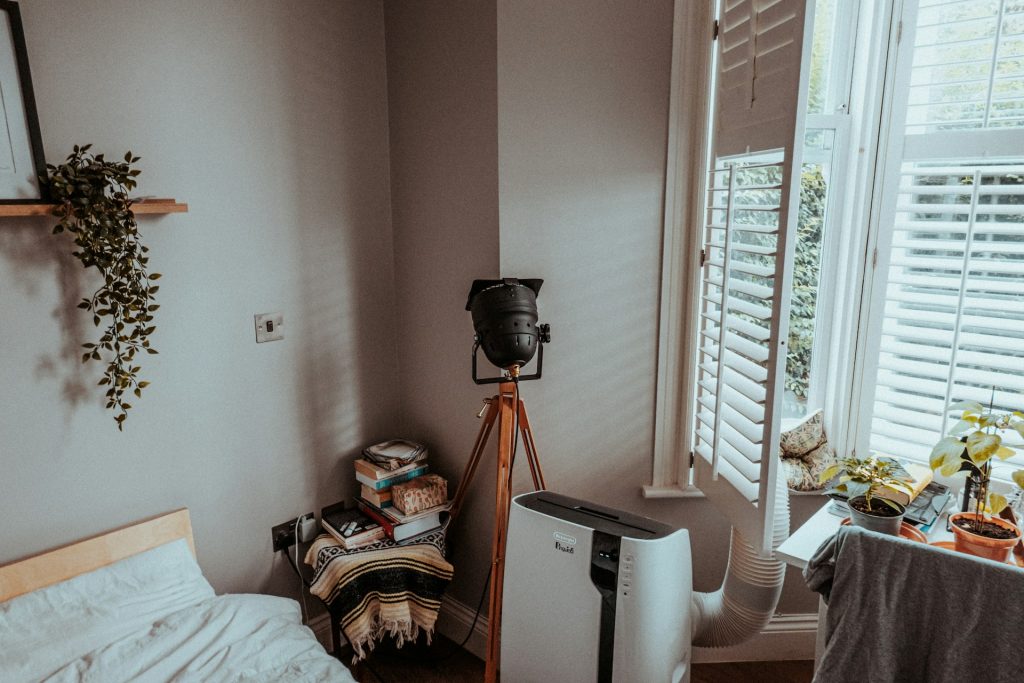
A portable air conditioner needs to exhaust heat outside.
Before buying, check:
what style of window you have
whether the supplied kit fits
hose diameter
hose length
whether a fabric seal is required
whether your landlord permits permanent alterations
Portable units commonly include kits intended for sliding or sash windows, but casement windows often need a different sealing arrangement.
A badly sealed window can undermine even a correctly sized machine.
What About Two Rooms?
Portable air conditioners are best thought of as room coolers, not central air-conditioning systems.
Trying to cool a bedroom and hallway and living room simultaneously through open doors makes the cooling requirement much larger.
Choose the room you’re using and isolate it where practical.
Running Cost Matters Too
Larger capacity generally means greater power consumption.
Before buying, check rated cooling input in watts as well as BTU.
Internal link: How Much Does a Portable Air Conditioner Cost to Run?
Bottom Line
Don’t choose portable AC purely by price.
Start with floor area, then account for:
sunlight + insulation + room position + occupants + heat-producing equipment.
For many ordinary UK bedrooms, around 9,000 BTU is a useful starting point.
For medium-sized living spaces approaching 20–30m², 12,000 BTU often makes more sense.
Correct sizing means better cooling, less frustration and a much better chance of the machine actually reaching the temperature you’ve selected.