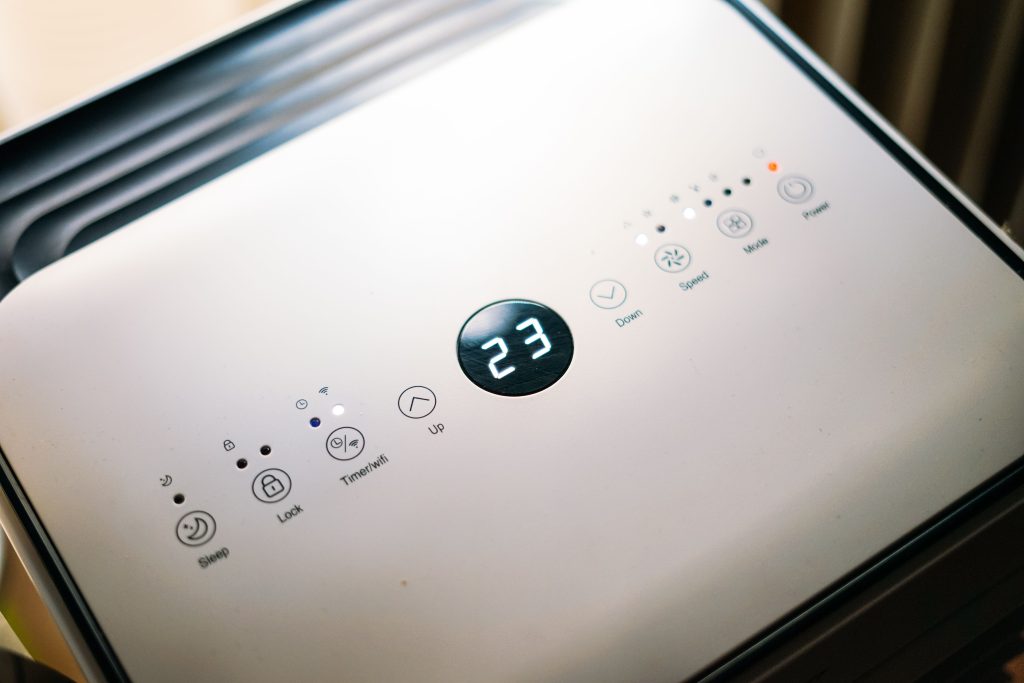

Does a Dehumidifier Help Condensation?
A dehumidifier can be very effective against condensation caused by excess indoor humidity.
It removes water vapour from the air before some of that moisture has a chance to condense on cold surfaces such as:
-
windows
-
external walls
-
tiles
-
window reveals
-
poorly insulated corners
But a dehumidifier does not repair leaking roofs, broken guttering, plumbing leaks, rising damp or water entering through defective walls.
That distinction is extremely important.
Why Does Condensation Form?
Air contains water vapour.
Warm air can hold more moisture than cold air.
When warm humid indoor air reaches a sufficiently cold surface, its temperature falls and some of that water turns into liquid.
That is why condensation is commonly found on bedroom windows on cold winter mornings.
Everyday activities continually add moisture to a home:
-
breathing
-
showering
-
bathing
-
cooking
-
boiling water
-
washing dishes
-
drying clothes indoors
Government ventilation guidance identifies all of these ordinary household activities as contributors to indoor humidity and warns that trapped moisture can lead to condensation and mould.
How Does a Dehumidifier Help?
A dehumidifier lowers the amount of water vapour in the air.
With less moisture available, there is less water available to condense when air meets a cold surface.
Imagine two identical bedrooms with equally cold windows.
If one room is at very high humidity and the other has controlled humidity, the first room is far more likely to produce heavy condensation.
A dehumidifier helps shift the balance.
Will It Completely Stop Condensation?
Not always.
Condensation depends on both:
-
indoor humidity
-
surface temperature
A window can still become cold enough for condensation even when indoor humidity is fairly reasonable.
Single glazing, thermal bridges and very cold external walls can therefore continue to show some condensation.
The goal should be to control excess moisture, not assume that a dehumidifier can correct every building defect.
What Type of Damp Can a Dehumidifier Help?
Condensation damp
Yes — often very effectively.
This is its strongest use case.
Moisture from drying clothes
Yes.
A dehumidifier can collect water released by indoor laundry.
Moisture after a minor water incident
Potentially, once the source of the water has been dealt with.
Penetrating damp
No, not as a repair.
You need to identify where water is entering the building.
Rising damp
No.
Lowering indoor humidity doesn’t fix the structural cause.
Plumbing leak
No.
Repair the leak first.
Electrical Safety First likewise advises that a dehumidifier can help manage moisture but doesn’t fix underlying structural causes of damp.
What About Mould?
Reducing humidity can make conditions less favourable for future mould growth.
But simply running a dehumidifier does not mean an existing mould problem should be ignored.
Existing mould should be dealt with appropriately and the reason the area became persistently damp should be investigated.
Official UK guidance stresses that damp and mould problems should be addressed at their source rather than attributed solely to the behaviour of occupants.
Where Should You Put the Dehumidifier?
If condensation affects one room, operate the machine there.
If several rooms are affected, a central location such as a hallway or landing can sometimes work well, provided internal doors allow air to circulate.
Keep external windows closed while actively dehumidifying unless the manufacturer advises otherwise — otherwise the machine continually processes incoming outdoor air.
What Humidity Setting Should You Use?
For ordinary moisture control, there is rarely a reason to run a domestic dehumidifier continuously at its lowest possible setting.
A sensible starting point for many homes is around 50–60% relative humidity, then adjust according to conditions and your manufacturer’s guidance.
The humidistat can then cycle the compressor as required rather than operating continuously.
Don’t Forget Ventilation
A dehumidifier should not automatically replace good ventilation.
Extractor fans should work.
Trickle vents shouldn’t be permanently blocked.
Cooking moisture should be extracted.
Bathrooms need to dry after showers.
Government guidance specifically advises keeping trickle vents open, maintaining extractors and ensuring that moisture has a route out of the building.
Bottom Line
If the problem is condensation caused by high indoor humidity, a dehumidifier can make a substantial difference.
If the problem is water entering the building, the dehumidifier is treating the symptom rather than the cause.
Use it as part of a moisture-control strategy:
reduce moisture production + ventilate appropriately + maintain sensible heat + dehumidify when necessary + repair defects.
That approach is far more effective than relying on any single appliance.